Purpose
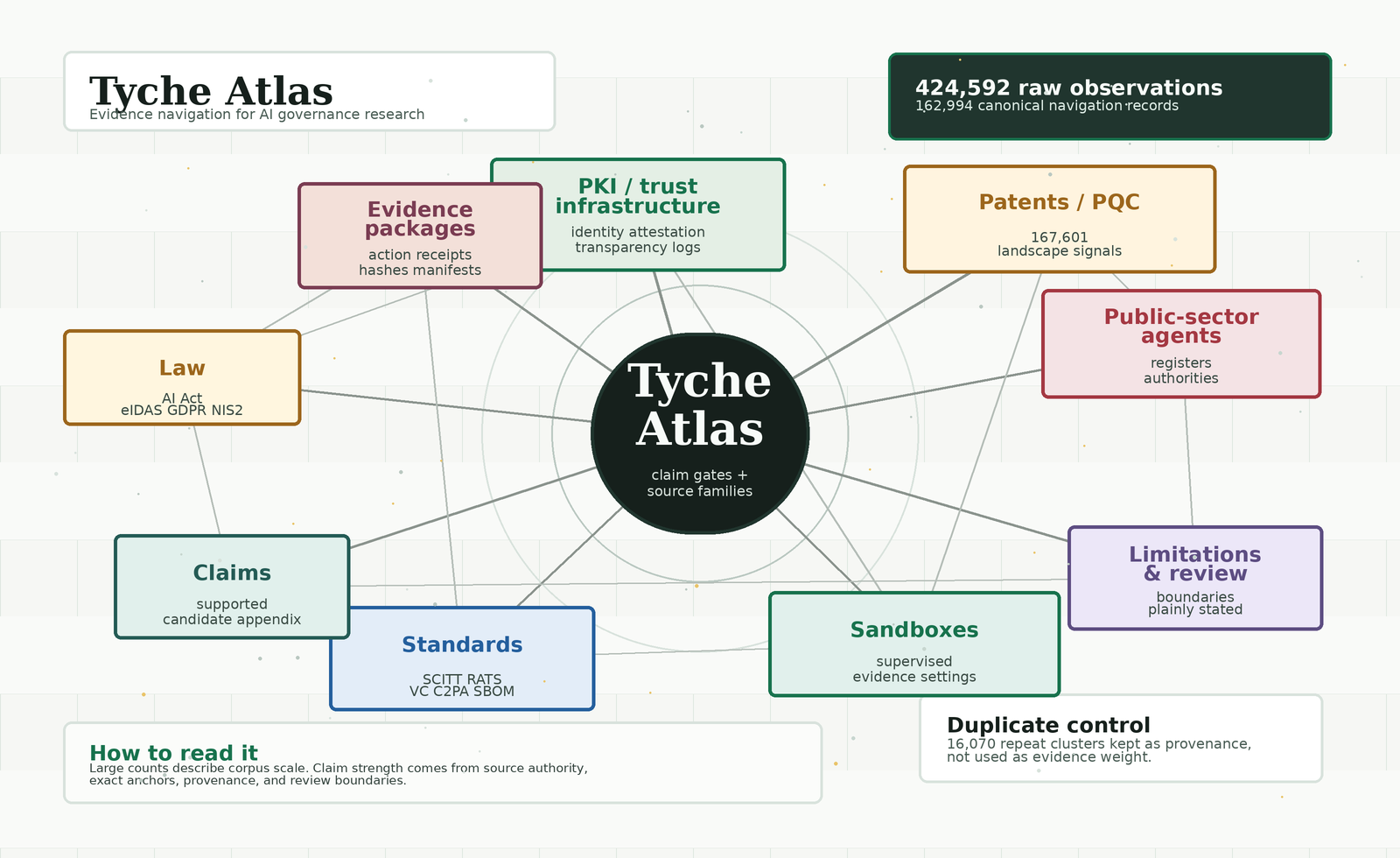
Atlas helps a researcher move from a governance claim to the evidence families that could support, weaken, or bound it.
Boundary
Public downloads are limited to the article PDF and versioned manifest. Raw histories and support materials stay in controlled release storage.
Observatory topics
The Atlas topic spine
AI law and governance duties
Legal sources and official materials used for candidate law-to-evidence crosswalks.
Standards and trust infrastructure
SCITT, RATS, C2PA, VC/DID, SBOM, provenance, signing, and transparency fragments.
Regulatory sandboxes
Evidence-producing settings with procedures, logs, technical records, and authority interfaces.
Public-sector agents and registers
Registers, public agents, authorities, and digital-government evidence surfaces.
Evidence packages and action receipts
Verifier-readable event records connecting identity, system state, evidence objects, and trust anchors.
Patents, PQC, and implementation signals
Technical imagination around cryptographic durability, identity, provenance, and AI accountability.
Claim support method
Each major paper claim maps to Atlas evidence.
The article PDF now includes an Atlas claim-support matrix. It links paper claims to support surfaces: manifests, codebooks, validation summaries, compact claim-verification tables, source-family records, and claim-status gates.
What Atlas is
A useful navigation infrastructure.
Human valueFind source families, claim support status, and context signal families for a research claim.
Research valueVersioned corpus design, deduplication, provenance, validation, limitations, and claim gates.
Publication objectThe method article describes the evidence infrastructure itself.
Evidence families
The useful human map
EU AI Act and adjacent law
AI Act, eIDAS/EUDI, GDPR, NIS2, Cyber Resilience Act, Data Act, and Product Liability sources are routed as candidate law-to-evidence crosswalks until exact clause checks are complete.
Trust and evidence fragments
SCITT, RATS, COSE/JOSE, VC/DID/Data Integrity, C2PA, SPDX, CycloneDX, SLSA, Sigstore, and in-toto appear as partial evidence functions.
Evidence-producing settings
Regulatory sandboxes are treated as governance research settings that can generate logs, technical documentation, authority summaries, and review surfaces.
Agents, registers, and authorities
Algorithm registers, public-sector agent materials, national digital authorities, and supervisory surfaces are mapped as schema analogues and public accountability surfaces.
Action receipts
Atlas models signed, verifier-readable event records that connect actor identity, system state, evidence objects, timestamps, and trust anchors as a research construct.
Implementation imagination
Patent and post-quantum cryptography records show where actors describe trust, identity, provenance, cryptographic durability, and AI-accountability patterns.
Patents, PQC, AI
Implementation signals with bounded interpretation.
| Signal family | Examples in Atlas | Safe public interpretation |
|---|---|---|
| PQC and quantum-resilient trust | post-quantum cryptography, quantum-key communication, quantum threat detection, smartcard PQC | landscape signal for trust-infrastructure research |
| PKI / identity / credentials | eIDAS/EUDI, verifiable credentials, decentralized identity, signed contracts, device certificates | partial evidence-carrier families |
| AI accountability | AI Act evidence, model documentation, algorithmic accountability, public registers, public-sector agent surfaces | candidate governance evidence map |
| Software supply chain | SBOM/provenance, transparency logs, certificates of authenticity, data provenance | reusable evidence fragments |
Claim support
Strong, candidate, or appendix-only.
Use now, cautiously
Atlas as a citable research object; action receipts as a proposed research construct.
Candidate after verification
Law-to-evidence crosswalks, standards fragments, sandbox evidence infrastructure, public-register schema analogies, and selected comparators.
Appendix or separate paper
Pallas-style readiness and patent landscape slices work best as adjacent or separate-paper material.
Count discipline
Scale is visible. Repetition is controlled.
Repeated crawl and export observations remain in audit records. The public portal foregrounds raw scale, canonical records, and duplicate clusters. Claim support uses source authority, exact anchors, and canonical records.
Reviewer risks
Plainly stated.
Atlas records are canonicalized, deduplicated, grouped by source family, and tied to claim gates. Large counts are corpus-engineering facts. Legal and standards claims stay candidate until exact clause, version, and section anchors support them. Patent and PQC records show implementation signals. Public registers are schema analogues. Publication, repository deposit, licensing, disclosure, and venue decisions remain author-owned steps outside this portal.